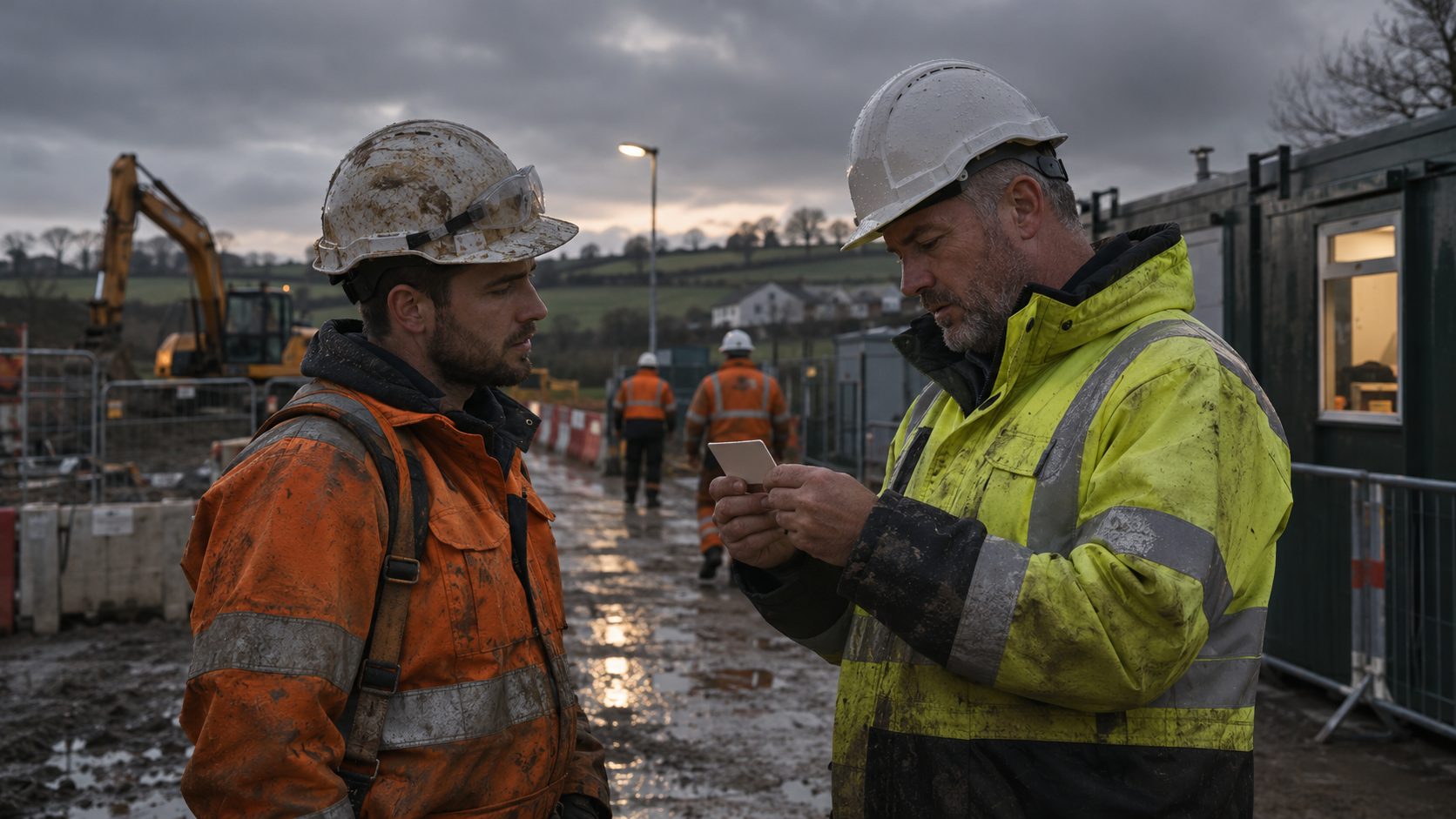
A worker turns up on site at 07:00. They've got their card. It's valid. The name matches. The expiry date is fine.
So they're good to go?
Not necessarily.
The card might confirm a qualification, a particular type of training or competence in a specific activity. But it doesn't tell you whether that person understands the risks on your site, has received the right briefing or is ready for the work they're about to undertake.
And that matters whether you're checking a CSCS card in Birmingham, an NPORS card in Manchester, a CSR card in Belfast or a Safe Pass card in Dublin.
Checking the card is essential. But checking the card isn't the same as checking the worker is ready.
What does a construction competency card actually prove?
Construction has a well-established system of cards and certifications.
In Great Britain, schemes include CSCS, CPCS, NPORS, ECS and other trade-specific credentials.
In Northern Ireland, there's the Construction Skills Register (CSR).
In the Republic of Ireland, SOLAS operates the Safe Pass programme and the Construction Skills Certification Scheme (CSCS), which is distinct from the UK scheme with the same initials.
They're not interchangeable, and they don't all demonstrate the same things.
Some provide evidence of general health and safety awareness. Others relate to occupational qualifications, particular skills or the operation of specific machinery.
A valid card can tell you something important about the person carrying it.
But none of these cards, on its own, answers every question about whether that person is ready to do a particular job on a particular site today.
The difference between a valid card and a ready worker
Imagine an experienced excavator operator arriving at a new construction project.
Their plant competency card is genuine. The relevant category is listed. Their certification is current.
That's a good start.
But have they been familiarised with the specific machine they'll be operating?
Do they know about the buried services on this site?
Have they received the current traffic management briefing?
Do they understand the exclusion zones, the ground conditions and the arrangements for working near other trades?
And has anyone established that they understood those instructions?
Their card isn't designed to answer those questions.
The site's induction, task briefing, training records and supervisory checks need to provide the rest of the picture.
It's why construction competence involves more than a card in someone's wallet.
Card checking across the UK and Ireland
The requirement is straightforward: establish which credentials are needed for the work and verify them through the appropriate issuing scheme.
In Great Britain, CSCS Smart Check provides digital verification of cards carrying the CSCS logo, including participating schemes such as CPCS and NPORS/CSCS.
In Northern Ireland, CSR provides its own online card-checking service.
In the Republic of Ireland, Safe Pass and SOLAS CSCS have their own requirements and administrative arrangements.
One country's verification system should not be assumed to validate every card issued elsewhere.
And where a worker crosses jurisdictions, the receiving contractor needs to establish whether the qualification or certification is recognised and suitable for the work.
That's the challenge for businesses operating across Britain and Ireland.
Different card schemes. Different credentials. Different site requirements.
But the same operational question:
Does this person meet the requirements to do this work safely and to the required standard?
From card checking to workforce readiness
At LUMA1, we call this Workforce Readiness.
It means knowing that each worker meets the requirements to do their work safely and to the required standard.
Those requirements will depend on the role, the task and the site.
We use the SKEB framework to think about the evidence:
- Skills: Can the worker demonstrate the practical ability required?
- Knowledge: Do they understand the relevant procedures, hazards and controls?
- Experience: Do their qualifications, credentials and work history support the assignment?
- Behaviours: Are the required working practices understood, reinforced and, where appropriate, observed?
A training card may contribute evidence to one or more of these areas.
But it rarely provides the whole answer.
A worker may have years of experience and still need a new site induction. A qualified plant operator may need machine-specific familiarisation. Someone who completed an induction last month may need a briefing because the site conditions have changed.
Readiness is specific to the work and the point in time at which it's being assessed.
How LUMA1 brings the evidence together
LUMA1 is The Workforce Readiness System.
It allows contractors to define what each worker needs before they're considered ready and bring the supporting evidence into one worker record.
Credentials, qualifications, inductions, training, comprehension checks, external training records and supervisor sign-offs can all contribute.
Workers and subcontractors can submit their records. Authorised managers can review credentials, monitor expiry dates and identify outstanding requirements.
For eligible UK cards, LUMA1's CSCS Smart Check integration supports digital verification through the relevant scheme.
For other credentials, including those used in Ireland, LUMA1 can hold, review and track the evidence, with issuer verification performed through the appropriate process. This is not a claim that every card scheme can be checked automatically.
The result is a clearer picture of whether the worker meets the defined requirements.
Cleared or Not Cleared.
And importantly, there should be evidence explaining why.
Why this matters commercially
Consider the costs of getting this wrong.
A subcontractor sends six workers to a project. Four have everything they need. Two have outstanding requirements.
If those gaps are discovered at the gate, the site team has a problem. People are waiting. Work may be delayed. Supervisors are chasing documents and making phone calls.
If the requirements are checked before mobilisation, the gaps can be identified while there's still time to resolve them.
There's an equally important benefit when a client or auditor asks for evidence.
You shouldn't have to reconstruct a worker's readiness from old emails, certificates, spreadsheets and someone's memory.
You should be able to show what was required, what was checked and what evidence supported the decision.
For principal contractors managing dozens of subcontractors, this is where contractor management becomes operationally valuable.
The question worth asking on your next site visit
Pick a worker who started today.
Find their competency card. Check that it's genuine, current and relevant to their assigned work.
Then ask what else they needed before they started.
Was the correct induction completed? Were the task-specific hazards understood? Was practical competence established where required? Were any outstanding requirements resolved?
Finally, ask whether you could produce the evidence without chasing three different people.
If the answer is yes, you've got a good basis for that readiness decision.
If the answer is no, the problem probably isn't the card.
It's the gap between the evidence you hold and the decision you're making.
Frequently asked questions
Can LUMA1 check CSCS and NPORS cards?
LUMA1 supports verification through the CSCS Smart Check integration for eligible cards carrying the CSCS logo. It also manages worker credential records and expiry dates. NPORS Traditional cards, which do not carry the CSCS logo, require their appropriate scheme-specific checks.
Can LUMA1 manage Safe Pass and other Irish construction cards?
Yes. LUMA1 can hold and manage credential records, review supporting documents and track expiry dates as part of workforce readiness. Verification against Irish issuing-body records must use the applicable process. Automated verification of every Irish card scheme is not being claimed.
Is a valid construction card enough to prove competence?
Not necessarily. A card provides evidence of specified training, qualifications or competence. Whether it is sufficient depends on the work being undertaken and the other requirements that apply. Site inductions, task-specific briefings, experience and practical assessments may also be needed.
Can a worker be Cleared for one site but Not Cleared for another?
Yes. A worker may have valid qualifications and completed the induction for one project but still need to meet additional requirements for another site or role.
Cards are evidence. Readiness is the decision.
Construction cards remain an essential part of verifying the workforce.
But knowing who's ready takes more than checking a number or scanning a card.
LUMA1 connects credentials with the other requirements that matter, helping contractors across the UK and Ireland make clearer, evidence-based decisions about who is ready to work.
Know who's Cleared. Know what's missing. Have the evidence.
LUMA1. The Workforce Readiness System.