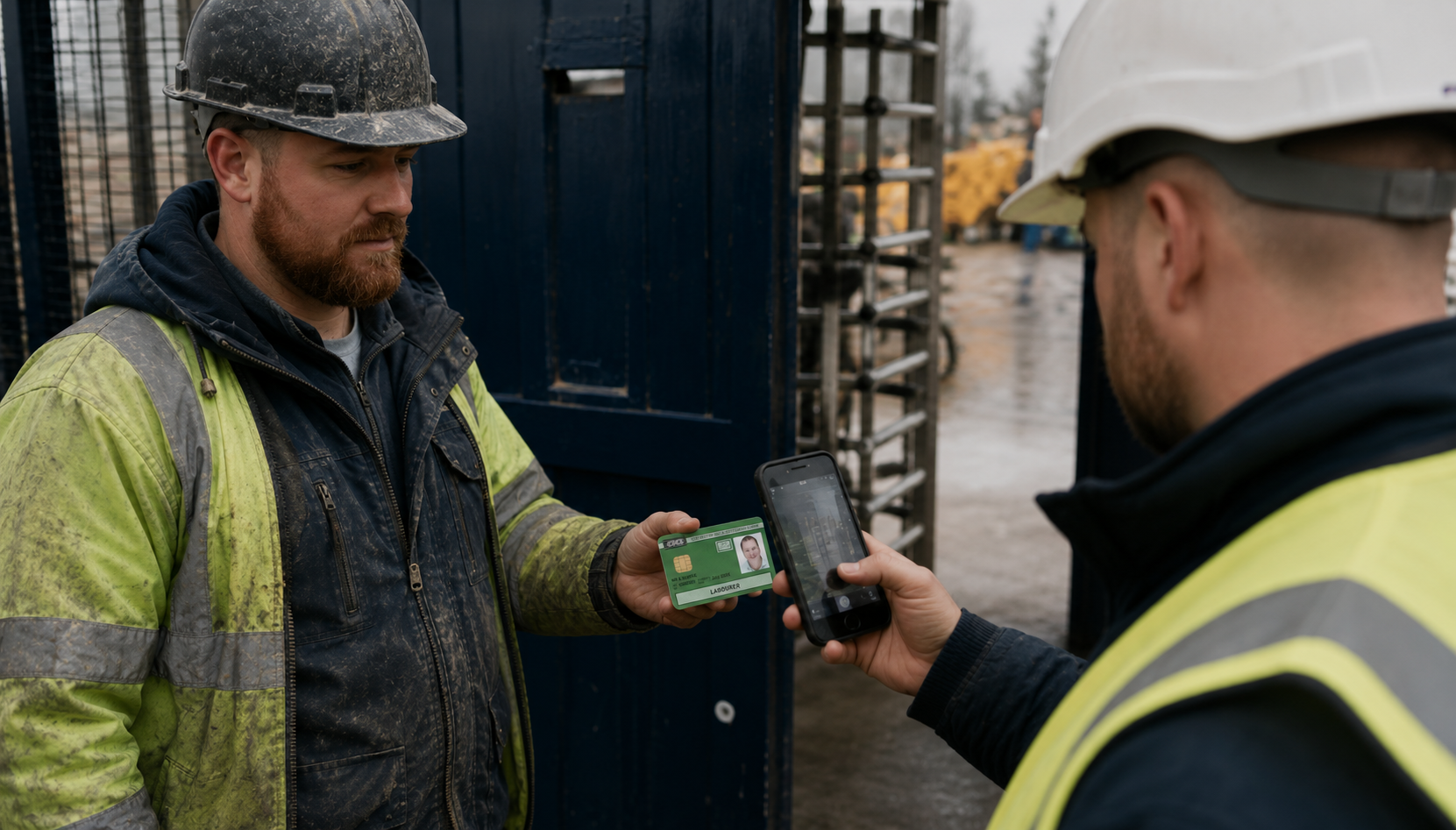
How to Check a CSCS Card Is Valid
The official ways to check a card, what the CSCS Smart Check API verifies across all 38 card schemes, and what a site team still needs before the worker starts.
Around 2.3 million construction cards carrying the CSCS logo are in circulation across the UK, spread across 38 CSCS Alliance card schemes. Every one of them carries an expiry date. Checking a card is quick. Knowing what the result means, and holding the evidence, is the part that decides whether a worker should be on your site this morning.
This guide covers the official manual checks, the CSCS Smart Check API that automates verification at the gate, and the gap between a valid card and a worker who is genuinely ready to work.
The Manual Ways to Check
Both are free, and both read from the same card records. Useful for one-off checks, but neither leaves you with an auditable, located record on its own.
A web form on the CSCS website. Enter the registration number printed on the front of the card, plus the holder's surname, and it returns the card type, the occupation and the expiry date.
Best when you have the card details written down, for example when checking a subcontractor's list before mobilisation.
A free mobile app that scans the QR code or chip on the card. It verifies cards from all 38 CSCS Alliance schemes carrying the CSCS logo, including CPCS, NPORS, NOCN, EUSR and JIB.
Best at the gate, because it confirms the physical card in the worker's hand rather than a number typed from a photograph.
If a check returns no record, treat the card as unverified rather than fake. Names get mistyped, cards get reissued, and some older cards were withdrawn from the scheme. Ask the worker to log in to their card account and confirm.
The CSCS Smart Check API
The Smart Check app is built on the CSCS Smart Check API, a digital verification service that checks all 2.3 million construction cards displaying the CSCS logo across all 38 CSCS Alliance card schemes. LUMA1 is integrated with that API directly, so verification happens at the point of entry without a manual step.
Verifies cards across all 38 CSCS Alliance card schemes, not just CSCS-branded cards. One check covers every trade on your site.
Captures and returns location GPS coordinates, a specific site ID, and the exact reason-for-read: routine check, site entry, or pre-induction.
Helps principal contractors meet requirements under the Building Safety Act and public procurement obligations with an auditable record for every read.
Because the API integrates directly into existing site access turnstiles, software and induction systems, the check runs in the background. The worker walks through the gate; the record is created automatically, stamped with where, when and why.
What to Read on the Card
A green card and a black card are not interchangeable. The colour and the occupation line matter as much as the expiry date.
Green is a labourer. Blue is skilled or qualified. Gold is advanced craft or supervisory. Black is management. White is professionally qualified.
The card names the trade it was issued for. A card issued for one occupation is not evidence of competence in another.
Most cards run five years. A card that expires mid-project needs a renewal date in your records, not a note in someone's head.
The number you enter into the checker, or that the Smart Check API reads from the chip. Record it against the worker so the check can be repeated later without chasing the card again.
Where the Card Check Stops
A card check is one of four things a site team needs before a worker starts. On its own it leaves three questions open, and a manual check leaves no lasting evidence that any of them were answered.
Identity
The checker confirms a card record exists. It does not confirm the person holding it is the person named on it. That is a gate check, done by a human, and worth recording.
Site-specific induction
The health, safety and environment test behind the card is generic by design. It says nothing about your traffic routes, your lifting operations, your confined spaces or your permit rules.
Understanding
A card proves a test was passed, in some cases years ago. Readiness means the worker has been briefed on today's hazards and has confirmed they understood them, with a dated record to show it.
This is the difference between holding records and being able to prove readiness. LUMA1 closes that gap by running the Smart Check API at the gate, then holding the result alongside the induction and the briefings against the worker and the site. Our guide to workforce readiness in UK construction sets out the full standard.
A Practical Card Check Routine
- Check before mobilisation, not at the gate. Ask subcontractors for card numbers with their labour returns and verify the list in advance.
- Scan the physical card on first arrival. Smart Check confirms the card is real and matches the record across all 38 schemes.
- Automate the re-check at entry. With the Smart Check API integrated into LUMA1, every turnstile read re-verifies the card and stamps the record with GPS, site ID and reason-for-read.
- Diarise the expiry. Flag renewals ahead of the date so a valid worker does not become an unverified one overnight.
- Attach the induction and briefings. The card sits alongside the site-specific evidence, not instead of it.
Common Questions
How do I check a CSCS card online?
Use the official CSCS Card Checker at cscs.uk.com, or scan the QR code printed on the card with the CSCS Smart Check app. Both return the card type, the holder's name and the expiry date. The app also reads cards issued by any of the 38 CSCS Alliance schemes carrying the CSCS logo, such as CPCS, NPORS and NOCN.
How do I check if my CSCS card is still valid?
Enter the registration number from the front of the card into the CSCS Card Checker. If the card has expired, been revoked or was never issued, the checker will not return a valid record. Cards are normally valid for five years, so check the expiry date rather than assuming.
What is the CSCS Smart Check API?
The CSCS Smart Check API is a digital verification service that checks all 2.3 million construction cards displaying the CSCS logo across all 38 CSCS Alliance card schemes. It integrates directly into existing site access turnstiles, software and induction systems, so verification happens automatically at the point of entry rather than as a manual step.
What data does the CSCS Smart Check API return?
As well as confirming the card is valid, the API captures and returns location GPS coordinates, a specific site ID, and the exact reason-for-read, such as a routine check, site entry or pre-induction. That means every check is a dated, located record rather than a one-off look at a card.
What does a CSCS card actually prove?
A CSCS card proves the holder has passed a health, safety and environment test and holds a relevant qualification for their occupation. It is evidence of knowledge. It does not prove the worker has been inducted to your site, understands your hazards and controls, or holds the other tickets the task requires.
Can a worker start on site with a valid CSCS card alone?
No. A valid card is a starting point, not clearance. Before work begins you still need identity, a site-specific induction, any task-specific tickets, and a record that the worker understood the rules they were briefed on.
How does the CSCS Smart Check API help with Building Safety Act compliance?
The Building Safety Act and public procurement obligations require principal contractors to hold evidence of competence. Because the API records who was checked, when, where and why, every read is an auditable compliance record. LUMA1 holds those records against the worker and the site so the evidence is available on demand.
How often should site teams re-check cards?
Cards expire, get revoked and get replaced while a worker is still on your site, so a one-off check at the gate goes out of date. With the Smart Check API integrated into LUMA1, re-verification happens automatically on every entry, so the record stays current without manual effort.
Cards Are One Input. Readiness Is the Answer.
LUMA1 runs the CSCS Smart Check API at the gate and holds the result alongside inductions, briefings and attestations against every worker on every site, so the status is one word and the evidence is one link.